By Sophia Ehlers
An MSU student reflects back on a nostalgic era spent in a house of wonders, a place previously owned by a Michigan librarian and her cats, where she lived with her college roommate.
My college roommate Lucy has a home of her own, in a town outside of the perimeters of our shared apartment, but it wasn’t because she won the lottery or had it bought for her–her mother passed away in October 2021, leaving it in her name. Since then, she has been slowly but surely getting the boxes and bins sorted through, deciphering through what to keep and what to donate–each and every room, from the office to the basement. I’m very familiar with this house; a safe haven I have stayed at during difficulties with my own family, where it was not a good environment for me, or where I was a bad energy for them. While I can never repay my friend for this kindness, I write this ode, a sentiment. I wish her and her mom could know just how fond I am of the house I am lucky enough to temporarily call home.
At times, Lucy and I would stumble spontaneously upon the strangest, at times obscure, items. On a shelf with CDs and novels, including Fleetwood Mac’s “Rumours,” and Nathaniel Hawthorne’s “The Scarlet Letter,” there was a vinyl coffee cup with glossy brown filling of the same material, which served as the “coffee.” Next to the mug was a scattering array of chocolate chip cookies, also vinyl. All was attached (with no chance of ever coming off) to a toy plate. The thing looked straight out of a doll set, only it was life-sized. Where had such a thing originated from?
One bright August day, we took the CDs to a music shop, seemingly in the middle of nowhere. We thought for certain we had the wrong address at first, due to the fact that the building was on the border of two towns, an industrial place surrounded by warehouses, with a single truck resting in the lot.
People hold various opinions of summer 2025, and if one is going based purely on political, economic, or pop-cultural events, then perhaps it wasn’t the best, sure. But the people one surrounds themselves with are crucial, and can make or break entire periods of one’s life. The memories I made that summer I wouldn’t trade for anything.
The two of us took the CDs into the building, our only confidence that this was the correct location the fact that there was a thin paper sign in a window; and that was how we knew, from that decrepit indication, that we were at the right place. After a laugh, we went inside, and that was where we found a lone man with records and music. He was standing outside of a cramped office overflowing with a variety of unsorted physical forms of music, in which we were not allowed to step foot in. He sifted through my roommate’s mom’s CDs, wrapping up the payment to Lucy of $20 by giving us both stickers on our way out containing his business information. He is a DJ of sorts, and runs the queue for a radio station. I still have it, he’s still around, and you can still give him your CDs, records, and cassettes in exchange for money.
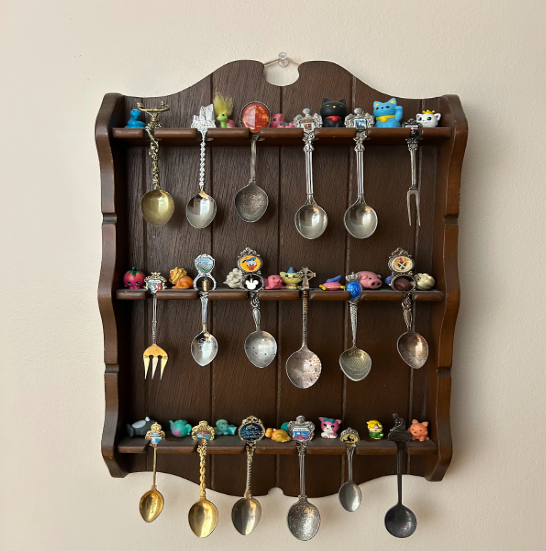
When the mysteries of the house weren’t leading us to new destinations, we were never bored on days we simply stayed within its shelter. The kitchen contained glassware with gumdrops of color on them, plates where you’d think the ceramic was used as a canvas for art, and spoons from more countries than one could count, hanging from a specialized wooden collector’s shelf. The shelf had small divots in the wood that held the spoons in place, as hangers would for clothes. Most of the spoons comprised silver-toned metals, but the occasional gold or brass was present. There was even a fork and a cheese spear among the spoons. On two layers of shelves containing the spoon-holding divots stood an array of miniature pencil toppers and other rubber animals which resembled them that we could get at our local mall years ago. The house and my childhood home were in the same neighborhood, so Lucy and I went to the same schools and grew up in the same community; I remember the first rubber pencil-topper I ever got was a red crab–by feeding a coin into the mall machine when I was six, my first one came to be in my possession. Lucy’s mom didn’t have any sort of crab, but she had a vast array of things including a tiger, lion, various housecats, a teapot, lamb, and penguin. I also distinctly remember a cluster of windchimes in the kitchen, attached to the window with a suction cup. At times, particularly when it got to be too humid in the summer, or when the glass became too cold in winter months, they would fall into the sink below and subsequently make the most absurd crashing noise. Once the jumpscare of the clattering was over, we both would laugh, or even mention it in passing: “remember when those windchimes fell the other day?” There was another set of windchimes, these more mushroom and lamp-like, with their own stand, resting atop a large windowsill between the den and the living room. Between the two versions of the windchimes, the house was filled often with song, brought on by a soft breeze.
There were two black cats who also loved the house that Marie had adopted: Suzette, who is around 14, and Anso, who is 8. They are both a bit quiet or reserved at first, but have larger than life personalities once one becomes familiar with them, and they no doubt are like that by having picked up the mannerisms and calm aura of their owner when she was around.
Marie adored black cats, had a wardrobe full of colorful knits and sweaters (but also several darker, mysterious clothing pieces one might find in a Londoner’s collection), owned and listened to a collection of 70s-90s music which included Fleetwood Mac and Souxsie and the Banshees, and worked at the town’s district library. She loved books, stones, agates, and anything unique, her house undoubtedly reflecting that. While I’ve never seen any of her writing, some say she liked to write, and after hearing that, I’m even less surprised to see that her house looks like that of a true artist–creatives truly tend to make their houses worth visiting. The rooms themselves serve as a museum of extraordinary things, a nod to her ideas and taste.
One of the boxes my roommate and I sorted through one day led me to discovering one of my most recent and longest-lasting hyperfixations: the fictional character of May Dodd, a woman who, in the 1870s, escaped a psychiatric ward to join the Cheyenne Native Americans to start a new life. Lucy told me to take whatever I wanted, and since Marie had multiple books on this topic, I took all of them. One was titled, “One Thousand White Women” by Jim Ferguson–but he also wrote another book, “Wild Girl”–of which Marie had a copy, so I took that as well. The whole box was filled with historical fiction, tales of times passed by, and Native American memoirs and novels. I also have one that isn’t about May Dodd specifically, but is just as interesting of a read.
Marie was a rather eclectic soul, and her archive of items is proof of a life lived with a never-ending curiosity in its truest form. She didn’t let the completion of her degrees–education for her undergraduate, and library and information science for her masters–stop her from treating life as it becomes when one manages to unplug: a constant journey of learning–a series of interesting events that teach as well as amaze. The living room, painted with a pastel hue not unlike that of salmon, serves as a gallery for large, framed textured canvas paintings made by Marie’s dad, Lucy’s grandfather. As one knows, rooms appear different depending on the time of day and type of angle they’re caught in, and depending on which internal lights are on. I can visualize the room in my mind’s eye at any time of day or night, particularly at night while Lucy and I would watch “Abbott Elementary” or “The Hunger Games” on the television. The walls would safely wind down with us for the evening, with the cats meowing at us while we worked on our scrapbooking pages or our Diamond Art canvases. Other gems of the living room could be seen in the decorative pillows, which appeared as though they came straight out of Vogue magazine; these, too, can be drawn to my mind without much effort. The pillows consisted of hues of deep violet, with gold tassels on the corners. Another decorative throw was mustard-colored with a sheet of gold metal chainmail stretched across the front, sewn into the middle seam so the back was still smooth. A very vintage black telephone rested nearby, complete with a dial and cord. On it still was a Detroit area code, written by a typewriter on a long since yellowed paper slid into a spot by or on the rotary dial. A circular, baby-pink wooden table greeted residents and visitors behind the couches, displaying small dishes of polished and unpolished stones and crystals, as well as miniature stone also made of stone, and trinkets.
The walls of the den between the living room and the kitchen were floral patterned, the color a subtle combination of bronze and pink to create a soft metallic hue, and perhaps the essence of a tea room.
In this way, the house, with all its collections of things: wooden shelves with no shortage of interesting items, plates of rose bud China and the such peeking through glass cabinets; near-perfect props, which include the pillows and that black telephone–plus the little animals, along with a faux plate holding the coffee mug and the vinyl cookies nearby–how could anyone think it was anything but a real, life-size dollhouse?
The quaint, windchime-filled home is expected to be put on the market in spring of 2026, around the time Lucy and I graduate from Michigan State University. While I look for work, I’ll be staying in the librarian’s home one last time while it waits to sell. This will be a concluding chapter to a house that’s seen people laugh and cry and gossip, rain or shine, sun or snow. Whoever occupies that house after we leave is undoubtedly going to be lucky, and I wish for them to make many good memories within, with hopes they take many trips to the library.
Sophia Ehlers is a senior double majoring in Human Resources and English. Her interests include fashion, historical fiction and old Hollywood movies. She can be found hiking or drawing in her free time.