By Maci Menard
January 17, 2025
Art has long been a powerful tool used as a form of protest and call for social change. Urban spaces have an extensive history of being used as a form of resistance, and printmakers have frequently produced works that address and reflect upon significant contemporary events. For thousands of years people have been drawing, painting and sculpting messages for public perception. Influential creators continue to challenge inequity and inspire collective action on a societal level through their creativity.
Most Americans recognize Paul Revere’s iconic engraving, “The Boston Massacre.” The events of March 5, 1770, played a significant role in influencing public opinion, driving the colony of Massachusetts toward revolution. The inaccurate image portrayed a line of British soldiers firing on a group of unarmed colonists. Although only 2 men were killed, the artist framed the event as a massacre, creating a powerful rallying cry that was widely proliferated, encouraging many reluctant colonists to consider severing ties with the monarchy.
A more recent example inspired by the Black Lives Matter (BLM) movement is Tanekeya Word’s 2020 poster, “We Were There. We Are Here. We Are In the Future.” The BLM movement is working to actively heal past injustices and invest in the future of Black lives through policy change, art and community. Word’s poster draws on womanism—a feminist movement that highlights the histories and experiences of Black women. The piece features a woman dressed in attire decorated with the names of Black female reformers, including pioneers from the African American women’s club movement and advocates for voting rights. Among these names are Charlotte Forten Grimke (1837-1914) and Carrie Langston (late 19th-early 20th centuries). Charlotte was an abolitionist and suffragist who taught school while working in the government, as well as a founder of the interracial Philadelphia Female Anti-Slavery Society. Carrie was a journalist who encouraged African American women to seek education, become politically active and enter the field of journalism. Word’s inspiring image serves as a beacon for young Black women of the future, symbolizing their legacy of activism.
We can recall, heartbreakingly, the devastating events of February 13, 2023 on MSU’s campus. MSU students rallied together after the shooting and pleaded for change. Some sought to express their feelings through art by painting the Rock on MSU’s campus. Known as “the Rock,” this mighty monument serves as a site for protests, celebrations, vigils and remembrances. Almost every day, students paint the Rock to promote an event or organization, to bring awareness to a topic, or to memorialize someone. In the aftermath of February 13, 2023, the students of MSU used the Rock to advocate for change and urge our society to do better.
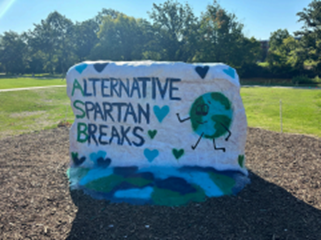
However, art doesn’t always have to address tragic events or sensitive topics. On the morning of September 9, 2024, I walked past the MSU Rock and encountered a painting promoting positive change. The message read “Alternative Spartan Breaks,” representing an organization dedicated to community service and volunteerism at MSU. I personally am a part of Alternative Spartan Breaks (ASB), and I am inspired by the work they do. ASB inspires me to lend a hand to those in need, facilitate a positive environment, and work hard to decrease disparities. Anyone who passed by the Rock on September 9 might have been motivated to join ASB or reminded to engage with their community, especially with the joyful imagery of hearts and a smiling globe.
Another caveat to think about when it comes to protest art is that it doesn’t always have to be done with a paint brush. It often manifests through photography, sculptures and even social media campaigns. Art goes beyond tangible forms, frequently serving as a visual plea for change. For example, Dorothea Lange’s photograph “Migrant Mother,” taken during the Great Depression, captures the harsh realities faced by a struggling farming family. The worn expression on the mother’s face combined with the children nestled against her creates an emotional resonance that evokes deep empathy. Lange’s photography highlighted the inequalities of her time, demanding attention and action, and these photographs are still well-known to this day.
Does art really change the world?
Art possesses the unique ability to stir emotions, spark conversations and challenge existing paradigms. It operates without strict rules and can take many forms to promote social change. If you have not already, I encourage you to click on the links within this article to view the discussed art and reflect on each piece. When viewing the images, did any of them provoke thoughts about your stance on social or global issues? Did they ignite even the smallest spark within you? The impact of art on our world is undeniable. It sheds light on pressing political and social issues, and when wielded as a tool for activism, it can foster meaningful change—uniting diverse groups and amplifying the voices of those advocating for justice.
If art can’t directly change the world itself, it sure has indirectly encouraged social change.
Maci Menard is a sophomore student at Michigan State University. She is a lifestyle photographer and has a passion towards the discussion on whether or not art has the ability to influence social change. Follow her photography Instagram account @macimenardphotography or view her portfolio on her website to see some of her work.