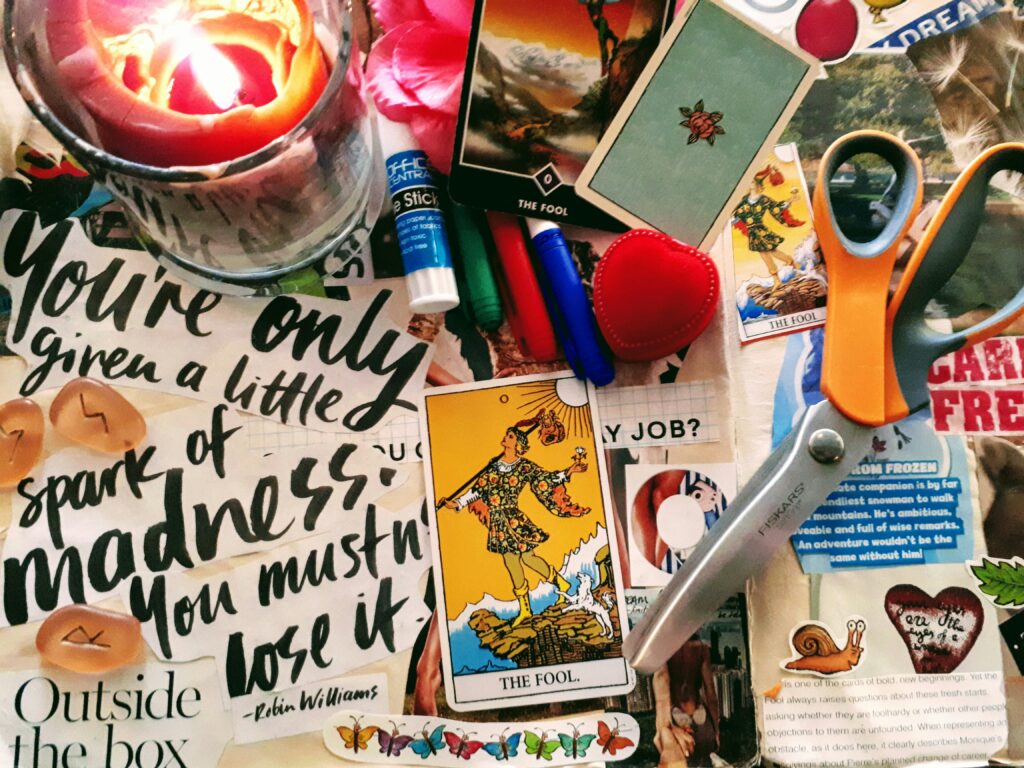
For many, receipts and junk mail are wastes of paper and nuisances destined for the dump. However, I don’t see them this way: I see sheer creative potential. Give me a stick of glue, and a couple of stickers and I can turn any piece of trash into a masterpiece worthy of an archive.
Junk journals are exactly what they sound like: journals where you can keep your junk. All of your needless scraps like receipts or business cards can find a home nestled between sticky, gluey pages. Personal archiving can help people connect deeper with themselves and their histories by allowing them to negotiate a personal space in the world. Junk journaling does just that and can be used to preserve feelings, memories, stories or events, making the past feel more tangible.
Keeping tangible memories is all the more special in such a digital age. In our western society we tend to document birthday cards, flowers, or gifts via photography without considering that there are other ways to preserve these important moments. Junk journaling has the ability to give us sneak peaks into the smaller scenes of the big moments by physically displaying notable snippets. Every year on my birthday, I open up one of my first junk journals that features a spread of birthday cards I received on my 18th birthday. I love seeing the wonderful notes from my loved ones and observing how our relationships have grown since then.
Junk journaling can serve as a creative way to collect memories and connect with our pasts, but it does not need to serve only this function. For many, junk journaling is strictly a creative practice because the great thing is: there are absolutely no rules. Sometimes I find a colorful business card or flyer on the wall that inspires me to create an entire design based off of it. This free-form style of journaling can look like whatever you want it to. Some use this exercise to create mood boards, plan their futures, or to de-stress. I’m sure we all have a random pile of paper scraps lying around waiting for something to be made of them.
In practice, junk journaling has looked like many things for me. In the past, I have made spreads that are mostly diary entries with a receipt or two from that day, or, I have made spreads that are full of color and whimsy from cafe logos, napkins and newspaper clippings. What I create depends on what my creative juices call for that day. The beauty of junk journaling is how accessible it is, allowing you to make decisions on the spot — tear it out, change it up and still love your creation in the end. No red pen needed.
Martina Calvi, author of “A Year of Journaling”, invites imperfection into her journaling routine. She said, “what I’ve learned from junk journaling […] is that there is beauty in the mundane and imperfect. By collecting scraps from your life to journal with, you start to see beauty in these tiny moments, no matter how ordinary.”
Imperfection contributes to junk journaling’s ability to function as an eco-conscious practice, which can have deeply anti-capitalist notions compared to other forms of journaling. For example, scrapbooking typically requires materials to be sourced from craft suppliers, and can be a costly endeavor. Junk journaling, as the name implies, encourages the notion of “reduce, reuse, recycle”. In my own practice I like to save my paper bags from the grocery store to cut patterns out of, or rip into funky shapes. All you need to do is give up the reins and let the junk flow — nothing needs to be perfect.
We accumulate so much junk on a daily basis. Coupled with a deep consideration for the wellbeing of our planet, the activity of junk journaling invites us to interrogate our daily interactions with our material possessions, making something beautiful out of nothing.
Mia Wertheimer is a junior studying English and professional and public writing. In her free time you can catch her junk journaling or cuddling with her cat, Drogo.